
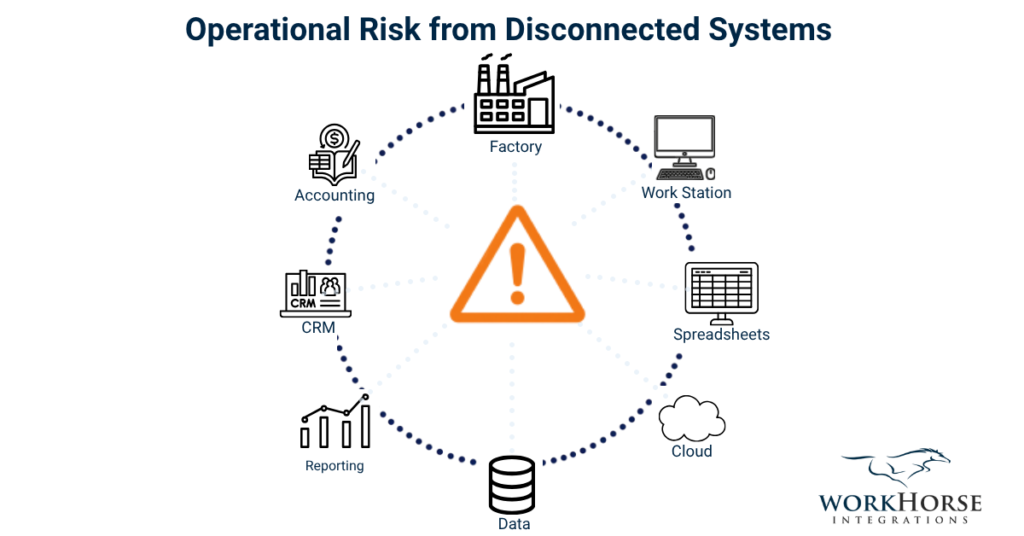
Operational risk from disconnected systems does not always look dramatic. It may look like a spreadsheet that only one person understands, a manual approval that lives in someone’s inbox, or a workaround the team has used for so long that no one questions it anymore.
Disconnected systems often start as an efficiency problem. Work takes longer. Reports need cleanup. Teams copy data between platforms. Customer updates require checking multiple systems.
Over time, those same issues can become a business risk.
When critical workflows depend on manual workarounds, the business becomes more vulnerable to errors, delays, employee turnover, missed steps, and unclear accountability.
That is why disconnected systems are not just an IT issue. They are an operational issue.
Where operational risk from disconnected systems appears
Operational risk from disconnected systems often hides inside daily work.
A team may use one platform for customer information, another for orders, another for finance, another for reporting, and a spreadsheet to connect the pieces. Each tool may serve a purpose. The risk appears when the business depends on people to move information between them.
A manual workaround may seem harmless at first. Someone exports a file every Friday. Another person checks two systems before responding to a customer. A spreadsheet tracks exceptions. An email thread approves the next step.
The process works until someone is out, something changes, or the data does not match.
That is when the business realizes the workflow was more fragile than it looked.
Manual workarounds create hidden exposure
Manual workarounds can create several kinds of business exposure.
They can increase data errors because people have to re-enter or reconcile information. They can slow response times because a workflow waits for one person to complete a step. They can make reporting less reliable because different teams may work from different versions of the truth.
They can also create continuity risk.
If only one employee knows how a process really works, that workflow depends on individual memory. If a spreadsheet becomes the unofficial system of record, the business may lose visibility into who changed what, when, and why.
Riskonnect discusses how organizations can replace spreadsheet-based business processes, legacy platforms, and manual processes with structured workflows that reduce administrative burden and improve business insight.
That concept matters beyond governance or compliance. It applies to any business process where manual workarounds have become too important.
Disconnected systems make accountability harder
Reliable operations depend on clear ownership.
A business should know where data comes from, which system owns the record, who approves the next step, and how exceptions get handled.
Disconnected systems make those answers harder to find.
When a customer record does not match an invoice, which system should the team trust? When a shipment update does not appear in the CRM, who owns the correction? When a report looks wrong, does the issue come from the data source, the spreadsheet, or the manual export?
Without clear system connections, teams spend time investigating instead of moving work forward.
That creates frustration for employees and uncertainty for leaders.
Integration can reduce risk without slowing the business down
Risk reduction does not have to mean adding more bureaucracy.
In many cases, better integration reduces risk by making the workflow clearer and more reliable.
A connected workflow can move information between systems automatically. It can update records consistently. It can trigger the next step. It can log activity. It can flag exceptions for review instead of leaving them buried in email or spreadsheets.
That does not remove people from the process. It gives people better visibility and reduces the repetitive work that creates avoidable mistakes.
Work Horse Integrations helps businesses connect systems, automate routine handoffs, and improve workflow reliability. The goal is not to make operations more complicated. The goal is to make critical processes easier to trust.
How to find hidden operational risk
A good place to start is with the workflows that feel most dependent on habit.
Look for processes that rely on one person, one spreadsheet, one manual export, or one undocumented workaround.
Then ask:
What happens if that person is out?
What happens if the spreadsheet breaks?
What happens if the manual step gets skipped?
What happens if two systems disagree?
How would we know the workflow completed correctly?
These questions help reveal operational risk from disconnected systems before the risk turns into a larger problem.
The Work Horse perspective
Disconnected systems are not only inefficient. They can make the business harder to manage, harder to scale, and harder to trust.
Work Horse Integrations helps businesses connect systems, automate routine handoffs, and improve workflow reliability. The goal is not to make operations more complicated. The goal is to make critical processes easier to trust.
Integration is not just about saving time. It is also about reducing risk.
 💡Tech Tip: Find the “only person who knows” process
Pick one important workflow and ask this question:
Who is the only person who knows how this really works?
If the answer is one employee, one spreadsheet, one inbox, or one undocumented workaround, that process may carry hidden operational risk.
Write down the steps. Identify the systems involved. Look for the point where the workflow depends on memory instead of structure.
That is often the best place to begin improving reliability.
Send Work Horse one process that depends too much on one person, spreadsheet, or manual workaround. We can help you find the risk point and identify a practical path forward.